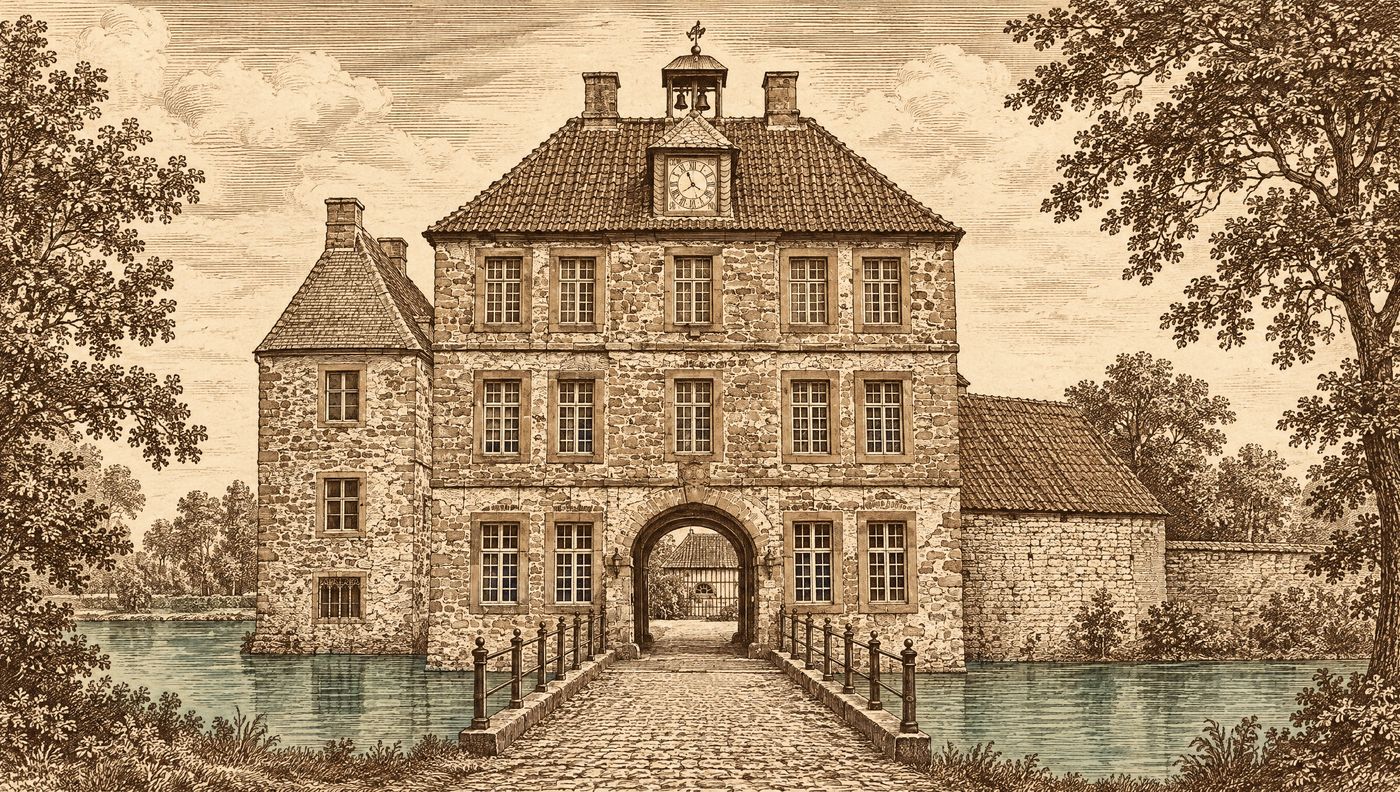
A noble seat on the water
Tatenhausen lies in the lowland of the Laibach stream, on the edge of the Tatenhauser Wald. The dammed stream still feeds the moats and the castle lake today. A fortified complex already stood on the site in the first half of the 14th century; the present castle rests on its foundations. The buildings originally stood on two islands.
Politically, Tatenhausen belonged to the County of Ravensberg and the parish of Hörste – not to the Prince-Bishopric of Münster, with which the later owners were closely connected.
The lords of Hoberg
The first known owners came from the von Hoberg family. Charters from the Tatenhausen archive name a Reinke Hobreg in 1455 and the brothers Hinrick, Otte, Regneke and Bernd Hobergh in 1476. The knight Bernd von Hoberg is recorded as lord of Tatenhausen in 1491 – this is regarded as the first mention of the estate.
Bernd was succeeded by his son Jobst. Jobst’s daughter Else, also called Elske in the sources, became the heiress of Tatenhausen.
Inheritance by the Korff family
In 1524 Else von Hoberg married Heinrich Korff genannt Schmising of Haus Harkotten. He brought with him his father’s estate, Gut Lonn near Telgte, and farms in the Münsterland. It was through this marriage – not through a purchase – that Tatenhausen came to the Korff family, who owned it until 1995.
On the date. The sources give different years for the transfer of the estate: the marriage is documented for 1524, the Bau- und Kunstdenkmäler of 1909 give 1525 for the transfer to the son-in-law, and the town of Halle gives 1543.
The new building of 1540
Heinrich Korff had the castle rebuilt from 1540 onwards. On the stair tower, a coat-of-arms panel with a double coat of arms and the inscription “anno dni 1540” commemorates the builder. The main house and the first east wing were built in the Weser Renaissance style; over the following two centuries the complex continued to grow. More on this can be found on the Buildings page.
Rise in the 17th and 18th centuries
Kaspar Heinrich von Korff genannt Schmising (1616–1690) served as a councillor in Brandenburg service – Brandenburg held the County of Ravensberg – and was at the same time Drost (bailiff) of Iburg. Thereafter the family increasingly turned towards the Prince-Bishopric of Münster: in 1683 it acquired a Burgmann estate in Nienborg, and in 1684 it was admitted to the Münster knighthood.
On 4 September 1692 the family was raised to the rank of Imperial barons in Vienna. Its landholdings also grew during this period. Acquisitions included:
- 1687/88 Gut Wittenstein in the parish of Versmold,
- 1706 Gut Duderstadt and 1707 the Grotenburg,
- 1710 Engsterstein in the parish of Dülmen and 1712 Bellering in the parish of Laer, both through a cathedral canon of the family,
- 1717 Gut Wieck and 1721 the Masthof, which another cathedral canon of the family bequeathed to the head of the family.
Several members of the family made careers in the Church and in administration, as Drosts, cathedral canons and envoys. The most important of them are presented on the Families page.
Fee tail and crisis
On 14 June 1778 the property was settled as a fee tail (Fideikommiss). This legal form was intended to hold a family’s wealth together permanently: the estates could not be divided or freely sold and passed on according to a fixed order of succession.
It did not, however, protect the property from debt. When Clemens August Heinrich von Korff genannt Schmising took over the estates in 1785, they were facing bankruptcy. He succeeded in saving them.
Upheaval around 1800
With the end of the Holy Roman Empire, the world of the Westphalian nobility changed fundamentally. The Prince-Bishopric of Münster, in which many family members held office, was occupied by Prussia in 1802 and dissolved in 1803. Bokel belonged to the Kingdom of Westphalia from 1807 to 1813 and in 1816 became part of the newly formed Prussian district of Halle.
On 17 January 1816 Clemens August Heinrich was raised to the rank of Prussian count. His son Maximilian Frederik Hendrik, Drost of Cloppenburg until 1811, then withdrew to Tatenhausen. His younger brother Franz von Korff genannt Schmising-Kerssenbrock, lord of Schloss Brincke, became the first Landrat (district administrator) of the district of Halle in 1816.
A poet at Tatenhausen
From 1812 to 1816 Friedrich Leopold Graf zu Stolberg-Stolberg lived at Tatenhausen with his family. The poet and translator, born in Bramstedt in 1750, had belonged to the Göttinger Hainbund in his youth. He was related to the Korff family: his daughter Julie married Franz von Korff genannt Schmising-Kerssenbrock in March 1812. The virtual museum of the town of Halle describes the stay as a refuge from French surveillance.
In the autumn of 1816 Stolberg moved to Gut Sondermühlen near Melle, where he died on 5 December 1819. He was buried in Stockkämpen. Graves of the comital Korff-Schmising family also lie there; their former mausoleum now serves as the cemetery chapel.
On the date. Most sources give 1812 to 1816. A Wikipedia article on the locality of Bokel, by contrast, gives 1810 to 1813.
Estate and manorial lordship
The castle was the centre of a manorial lordship. Tatenhausen included farms whose peasants owed dues and services to the lords of the manor. Records on the Tatenhausen tenant farms (Kolonate) in the parish of Werther cover the years 1455 to 1818. They deal with Wechselbriefe, Sterbfall and Freibriefe – the dues and documents of personal bondage (Eigenbehörigkeit) –, with manumissions around 1800 and with a lawsuit brought by the tenants against the Korff-Schmising family in 1812.
The estate archive is now held on deposit at the LWL-Archivamt für Westfalen in Münster. The charter collection alone comprises 658 charters from the years 1353 to 1909.
The 19th and 20th centuries
In the 19th century Tatenhausen remained a manor (Rittergut) and family seat. For a time it was also a spa – the Spa page tells that story. Two lords of Tatenhausen headed the district of Halle as Landrat: Klemens Graf von Korff genannt Schmising (1804–1882) from 1855 to 1875 and his son of the same name (1834–1921) from 1896 to 1911. In 1842 the elder also bought the neighbouring Gut Steinhausen at auction.
Around 1904 Maximilian von Korff-Schmising (1870–1951) took over Tatenhausen; he had previously lived at Steinhausen for some years. The accessible sources contain hardly any information about Tatenhausen during the National Socialist period and the post-war years.
In 1995 the Korff-Schmising family’s ownership ended after more than 470 years. Through inheritance Tatenhausen passed to the Teuffel von Birkensee family, who are descended from the Counts of Korff-Schmising.