The springs
Mineral and mud springs rise near the castle. One was used for drinking cures, the other for bathing cures. For a long time they went unnoticed because their water drained into a nearby mill stream and mill pond.
How people became aware of them is told in 1830 by Rudolph Brandes, an apothecary from Salzuflen, and Karl Tegeler: around 1795 a farmer named Nagel, who lived near the springs, regularly drank the water while working in the fields – and he and his fellow workers got diarrhoea every time. Soon the people of the neighbourhood were taking the water on purpose, against constipation, leg sores, glandular complaints in children, gout and persistent eye complaints, at first without medical advice. The mud of the springs came into use as well.
Local people had noticed several things before: an ochre-coloured deposit, an iridescent film on the water, no fish or frogs, and springs that never froze. The late Obermarschall (chief marshal) Count von Schmising therefore had today’s drinking well enclosed and the water analysed. The first analysis was made by Professor Bodde in Münster but never published. It was then repeated by the well-known spring analyst Westrumb, who found carbonic acid, “sulphurous air”, salts, magnesia, lime and iron, among other things. In 1799 Professor Detten of Münster described the „neu entdeckten eisenhaltig-salinischen Schwefelbrunnen zu Tatenhausen“ (newly discovered ferruginous-saline sulphur spring at Tatenhausen); in the same year the spring was bored.
On the discovery. When the springs were discovered is uncertain. Wikipedia and the City of Halle give 1720, based on a report from the mid-18th century. The oldest work consulted here, the 1830 book by Brandes and Tegeler, tells the story of the farmer Nagel around 1795 instead; the virtual museum of the City of Halle follows it. Brandes and Tegeler themselves consider it possible that the striking deposit of the springs had been noticed “now and then” before.
From spring to spa
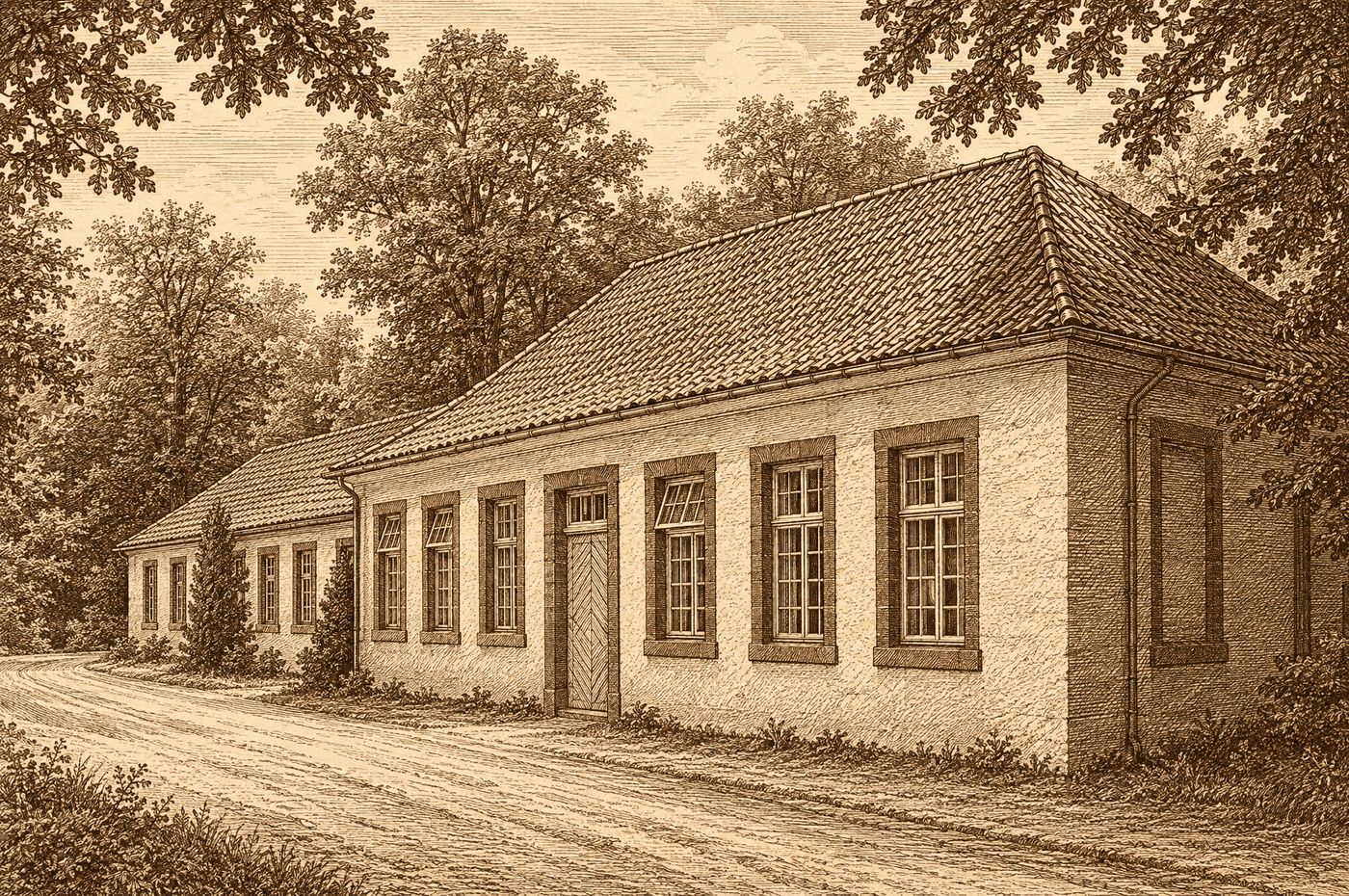

A proper spa establishment only came into being when Count Maximilian von Schmising – according to Brandes and Tegeler in 1830 – “laid the foundation of the present establishment about ten years ago”, that is around 1820. The virtual museum of the City of Halle calls him Maximilian von Korff-Schmising.
It began with a small bathhouse with two bathrooms and a heating stove. Demand was so great that a third room had to be fitted out the same summer; on average 40 to 50 people bathed each day. After two years the building burned down – in 1821, according to the virtual museum. It was replaced by the long stone building that still stands today.
At first it had six tall bathrooms with tubs of wood, stone and cast iron. Hot and cold water flowed in through double pipes, so that each guest could set the temperature; 25 degrees Réaumur, just over 31 °C, was usual. Because patients had to be turned away in 1825, the building was extended: by 1826 the number of bathrooms had doubled.
Steam baths were given in a separate room into which steam was piped from a boiler; the guest sat inside with the head outside. For the mud bath, trolleys of mud were pushed under the floor; an opening in the floor led into the mud bath. In the adjoining room a clear water bath was ready for rinsing off. There was also an apparatus for shower baths (“douche”) and two spacious rooms where guests stayed after bathing. During the season a physician came to Tatenhausen regularly and prescribed the baths.
In 1830 an assembly house was added, today’s Gasthof Tatenhausen. In 1831 guests had 45 rooms at their disposal, nine of them in the castle gatehouse. The complex was further extended until 1843.
Spa life around 1830
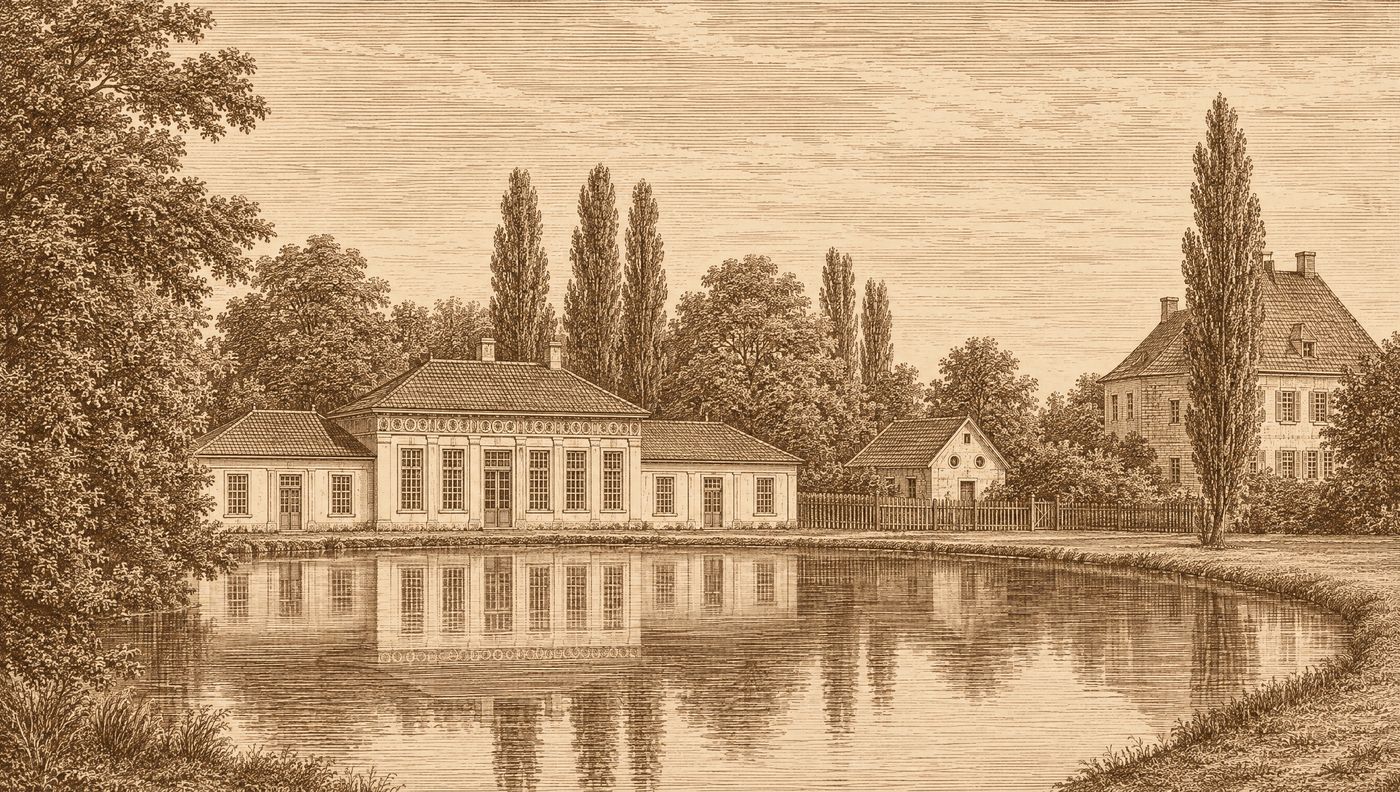
Brandes and Tegeler describe life at Tatenhausen as “rural and unconstrained, as it should be at a spa”. From the bathhouse an avenue of elms and larches led to the drinking well, which had been given a roof resting on large columns.
Guests lodged in the inn of the landlord Helling and in the lodging house with the assembly room, as well as in the gatehouse of the estate and with the forester, the gardener and neighbours. Rooms were allocated by the forester Schuhmacher. At Helling’s one dined at the table d’hôte or in one’s room; the prices were posted in the parlour.
A bath cost 3 to 6 Gutegroschen, mud and shower baths a little more. Poor patients bathed free of charge if they brought a certificate from their parish authorities or their pastor.
Gambling was not permitted; billiards and skittles passed the time. On Sundays people from the neighbourhood came, a band played wind music in the open air, and in the evening there was dancing in the ballroom of the assembly house. Those who wanted to read could obtain books from the lending libraries in Münster and Bielefeld, with which Tatenhausen had regular postal connections. From 1839, according to the virtual museum of the City of Halle, there were regular balls on Sundays.
The heyday
The spa flourished from 1819. The most successful year on record is 1826: 1,020 spa guests and 6,554 baths were counted. According to Brandes and Tegeler, guests also came “from very distant parts”; in 1828 they took “over 5000” baths. According to the virtual museum, they sought relief from rheumatism and from bone and nerve complaints.
The 1830 book also mentions old leg ulcers, glandular complaints in children, chronic eye complaints, chest and haemorrhoidal complaints, and abdominal ailments. The mud was applied externally.
On the healing effects. These are accounts from the early 19th century, not evidence of efficacy in today’s sense, and the disease names of the time do not match modern diagnoses. The book also describes the spa in consistently favourable terms. It is a source for the history of bathing culture, not medical advice.
What was in the water
Brandes and Tegeler devote most of their book to chemical analysis. Freshly drawn, the water of the drinking spring was bright and clear, smelled faintly of hydrogen sulphide and tasted slightly salty; exposed to air it turned cloudy, and when shipped in jugs it soon lost its sulphurous smell and taste entirely. The spring measured 10 degrees Réaumur (12.5 °C) when the air was at 15 degrees, and in spring only 5 degrees (just over 6 °C) with the air at 9. The bathing spring resembled it in appearance and temperature and yielded 8,256 Eimer (pails) of water in 24 hours.
In one pound of water from the drinking spring the authors found just under one and a half grains of solid matter, mainly carbonate of lime, together with iron, organic matter, gypsum, various salts and a little iodine, plus a small amount of carbonic acid and traces of hydrogen sulphide. The bathing spring had a similar composition. The authors themselves call the springs “not rich” in constituents – what struck them was the large volume of water and the heavy deposit.
The full 1830 analysis of the drinking spring
| Constituent | Grains |
|---|---|
| Carbonate of lime | 0.95340 |
| Carbonate of iron (ferrous) | 0.10972 |
| Nitrogenous organic matter | 0.09600 |
| Extractive matter | 0.09604 |
| Sulphate of lime (gypsum) | 0.04150 |
| Sulphate of soda, crystallised | 0.04076 |
| Chloride of magnesium, hydrous | 0.02802 |
| Silica | 0.02800 |
| Carbonate of magnesia | 0.02708 |
| Nitrogenous organic matter combined with silica | 0.02400 |
| Chloride of sodium (common salt) | 0.01102 |
| Lime as silicate | 0.00616 |
| Alumina with traces of iron oxide | 0.00600 |
| Phosphate of lime | 0.00400 |
| Iodide of sodium | 0.00360 |
| Sulphate of potash | 0.00358 |
| Bituminous resin | 0.00300 |
| Carbonate of manganese (manganous) | 0.00210 |
| Ammonium salt | traces |
| Total | 1.48398 |
They explain the deposit like this: “The carbonic acid escapes almost instantly as soon as the water touches the air.” The dissolved iron then rusts in the air and settles out together with silica, gypsum and organic matter, forming a reddish-yellow, jelly-like layer – the basis of the bathing mud.
On the figures. The values and names of substances reflect the chemistry of 1830 and cannot simply be compared with modern analyses. Pound, grain and pail were regional measures that varied from place to place, so they are not converted here. The degrees Celsius are calculated from the Réaumur figures.
The mud
There was mud in plenty. On the avenue between the bathhouse and the drinking spring, a mud spring rose from the ground so strongly that a large wheelbarrow-load could be removed almost every evening. The bathing and drinking springs together added another barrow-load a day. Four or five more mud springs lay half an hour away in the Diekbroker Wiese by the post road, on the only peat soil in the immediate area.
The mud was collected in a large basin. Fresh at the mineral springs it was reddish-yellow; in the basin it gradually turned dark green to black: very soft, slippery and fine, smelling faintly of hydrogen sulphide and later of bog. Brandes and Tegeler found iron, lime, gypsum, silica, alumina, resins, wax and plenty of nitrogenous organic matter in it. It was this in particular from which they expected “excellent effects” – one reason why the bathhouse was equipped to give several mud baths a day.
Decline
From 1855 the mud baths in particular were in demand. In the 1870s a leaseholder named Hoffschulte once again brought in more guests. After that the business declined; in 1903 the dilapidation of the facilities was lamented. The buildings survived and are used today for hospitality. The Old Bathhouse and the Gasthof are listed monuments.
On the decline. The sources date the end of the heyday differently: the virtual museum of the City of Halle around 1860 (with a final upturn until 1879), the City of Halle 1889. Wikipedia mentions a decline towards the end of the 19th century without giving a year.